AI as Clinical Labor · Part 2 · Free reference
The Clinical AI Autonomy Ladder
How much work can AI do on its own? Six levels of delegation help teams describe what AI may do, what people must still do and where approval or escalation belongs.
A stronger clinical team for a healthier tomorrow.
Same purpose. Greater possibilities.
An original delegation framework, not a validated maturity, clinical-risk or regulatory scale. Examples are illustrative; classify the deployed task, not the product name. Higher autonomy is not the goal.
Version 1.1 · Editorial review 2026-09-30. Educational framework; not clinical guidance.
Classify the deployed task
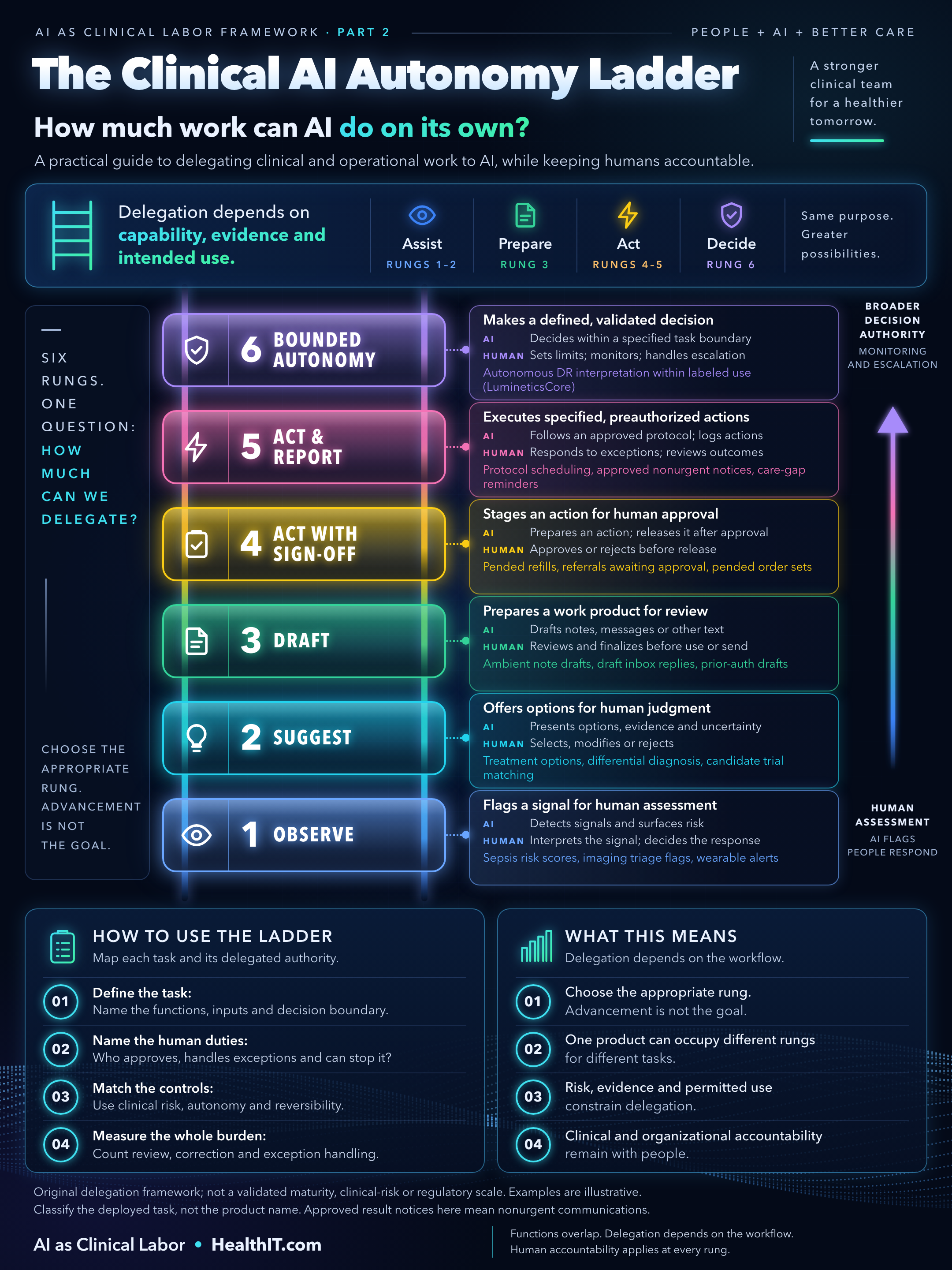
Six rungs of delegation
1. Observe
Flags a signal for human assessment
AI: Detects signals and surfaces risk.
Human: Interprets the signal and decides the response.
Examples: Sepsis risk scores, imaging triage flags, wearable alerts.
Boundary: Fits this rung when the system flags a signal and a person decides the clinical response. High clinical risk can occur at any rung.
2. Suggest
Offers options for human judgment
AI: Presents options, evidence and uncertainty.
Human: Selects, modifies or rejects.
Examples: Treatment options, differential diagnosis, candidate trial matching.
Boundary: Recommendations support human assessment. Candidate trial matching does not establish eligibility or enrollment; generated rationale is not proof of faithful reasoning.
3. Draft
Prepares a work product for review
AI: Drafts notes, messages or other text.
Human: Reviews and finalizes before use or send.
Examples: Ambient note drafts, draft inbox replies, prior-auth drafts.
Boundary: Draft text remains under human review. A system that prepares an executable submission awaiting approval belongs on rung 4 for that step.
4. Act with sign-off
Stages an action for human approval
AI: Prepares an action; releases it after approval.
Human: Approves or rejects before release.
Examples: Pended refill orders, referrals awaiting approval, pended order sets.
Boundary: The executable action requires individual authorization before release. Automatic protocol-based refill or referral actions belong on rung 5 under this framework.
5. Act and report
Executes specified, preauthorized actions
AI: Follows an approved protocol; logs actions.
Human: Responds to exceptions and reviews outcomes.
Examples: Protocol scheduling, approved result notices, care-gap reminders.
Boundary: Use explicit rules and timely escalation. Result notices mean approved nonurgent communications, not unsupervised interpretation, treatment changes or critical-result management.
6. Bounded autonomy
Makes a defined, validated decision
AI: Decides within a specified task boundary.
Human: Sets limits, monitors performance, handles escalation.
Examples: Autonomous DR interpretation within labeled use (LumineticsCore).
Boundary: The autonomous decision here is interpretation of retinal images within the device's intended use. Staff acquire images; clinicians handle results, referrals and treatment. The AI does not perform the whole eye-care pathway.
Before delegating a task
- Define the task. Name the function or functions, inputs and decision boundary.
- Name the human duties. Record who approves, responds to exceptions and can stop the task.
- Match the controls. Use clinical risk, autonomy and reversibility to choose safeguards.
- Measure the whole burden. Count time saved after review, correction and exception handling.
- Choose the appropriate rung. Advancement is not the goal.
- One product can occupy different rungs for different tasks.
- Risk, evidence and permitted use constrain delegation.
- Clinical and organizational accountability remain with people.
The retinal-screening example
LumineticsCore, formerly IDx-DR, autonomously detects more than mild diabetic retinopathy in adults aged 22 or older with diagnosed diabetes and no previous diabetic-retinopathy diagnosis, using the supported Topcon NW400 camera. This is bounded diagnostic interpretation, not a complete eye examination or autonomous treatment. Trained staff capture images. The responsible clinical team reviews outputs, manages inadequate-image results and arranges referral or follow-up. Refer to current labeling for the complete indication, exclusions and warnings.
Connect delegation to your learning
Use oncology workflows to examine the task, supervision and evidence. Start with the free first lesson; modules 5 and 7 extend the exercise within the course.
The Oncology AI Landscape
Recognize the task behind an AI claim.
Course moduleOncology Workflow Fit
Map approval, exception handling and the whole burden of supervision.
Course moduleApplied Use-Case Memo
Describe a bounded use of AI with evidence and accountable human duties.
Sources and labeling
Explore on HealthIT.com
HealthIT.com provides the open reference library. The Academy connects these ideas to structured study, practical exercises and assessments. The course offers a Certificate of Completion; it is not CME or a professional credential.
Explore HealthIT's free resource libraryHealthIT.com is run by HealthIT, the company that operates Oncology AI Academy. Its resources are free and open.