AI as Clinical Labor · Free reference
The Healthcare AI Labor Stack
A thought framework for understanding where AI enters clinical and operational work. For clinicians, care teams, leaders, researchers and builders, it offers a shared language for discussing work, supervision and the connections between them.
Same purpose. Greater possibilities.
The aim is a more capable healthcare workforce in which people and machines each contribute to better care. Use oncology's complex, multidisciplinary workflows as a learning setting, then consider what transfers to your own part of healthcare.
Save it as a reference or share this page with your team. Educational framework; not clinical guidance or a validated maturity scale.
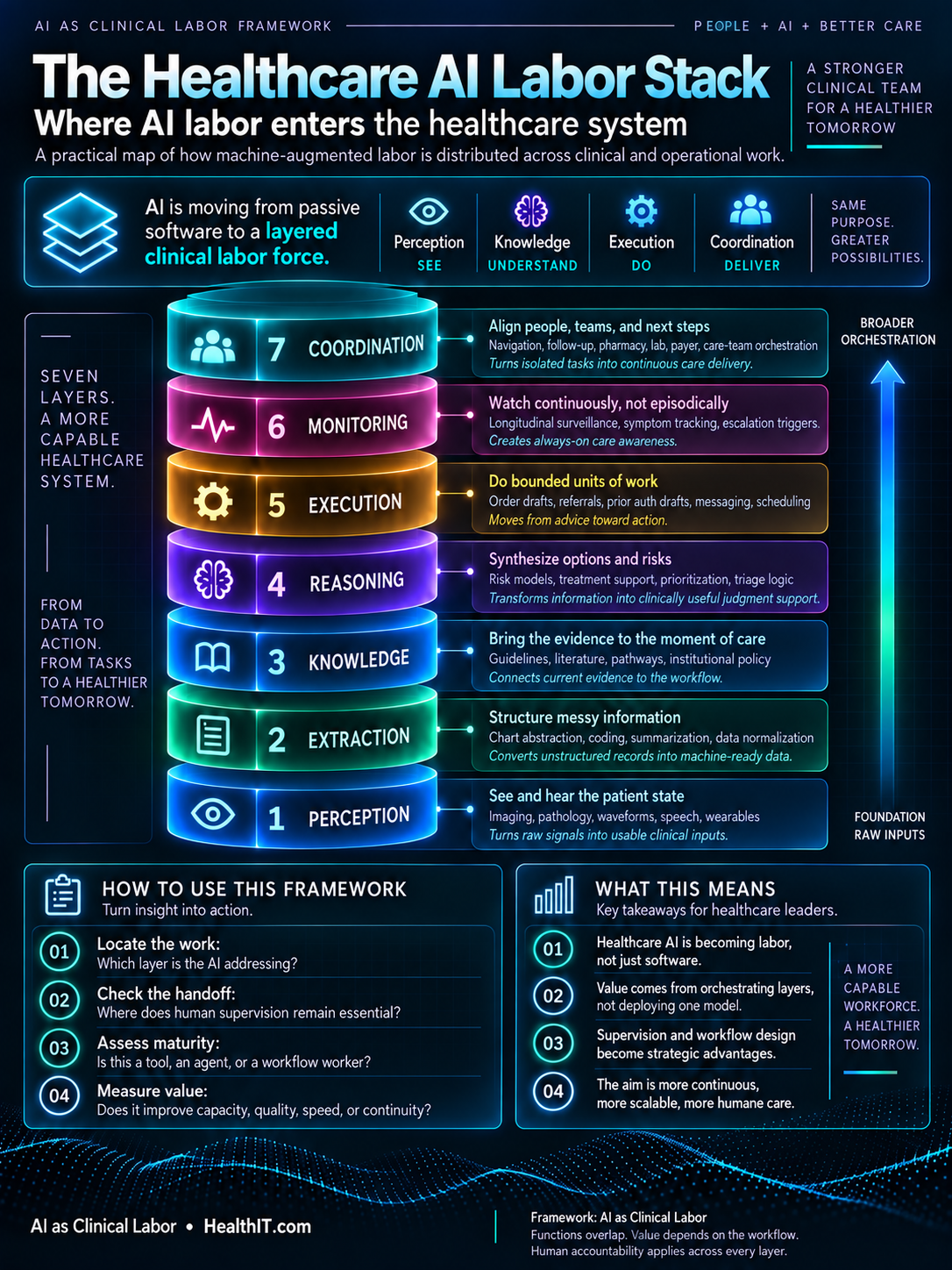
From data to action
Seven layers of work
The layers are a way to think about work, not a required sequence. A single workflow may span several layers; each still needs an appropriate scope, evidence and accountable human oversight.
1. Perception
See and hear the patient state.
Imaging, pathology, waveforms, speech and wearables turn raw signals into usable clinical inputs.
2. Extraction
Structure messy information.
Chart abstraction, coding, summarization and data normalization turn unstructured records into machine-ready information.
3. Knowledge
Bring evidence to the moment of care.
Guidelines, literature, pathways and institutional policy connect evidence to the workflow.
4. Reasoning
Synthesize options and risks.
Risk models, treatment support, prioritization and triage logic help people examine information and decisions.
5. Execution
Do bounded units of work.
Orders, referrals, prior authorization drafts, messaging and scheduling move from advice toward action within defined permissions.
6. Monitoring
Watch continuously, not episodically.
Longitudinal surveillance, symptom tracking and escalation triggers support follow-up between encounters.
7. Coordination
Align people, teams and next steps.
Navigation, follow-up, pharmacies, labs, payers and care teams connect around the next action.
Use it with your team
Four questions to start a discussion
- Locate the work. Which layers does this workflow involve, and what task is AI actually being asked to perform?
- Check the handoff. Where must a person review, approve or take over? What happens when the system is uncertain or wrong?
- Assess maturity. Is this a tool, an agent or a workflow worker? What permissions and boundaries does it need?
- Measure value. What would show an improvement in capacity, quality, speed or continuity, including the work of supervision?
Connect the framework to your learning
Start with the free first lesson. Modules 5 and 7 extend the exercise within the course.
The Oncology AI Landscape
Recognize the kind of work behind an AI claim.
Module 05 · Course moduleOncology Workflow Fit
Map handoffs and measure the whole workflow, including human review.
Module 07 · Course moduleApplied Use-Case Memo
Turn a proposed use of AI into a reviewable decision.
Part 2: The Clinical AI Autonomy Ladder
After locating the work, define how much AI may do on its own and which duties stay with people.
Explore the six levels of delegationExplore on HealthIT.com
HealthIT.com provides the open reference library and ongoing healthcare AI discussion. The Academy connects these ideas to structured study, practical exercises and assessments that help learners check their understanding. The course offers a Certificate of Completion; it is not CME or a professional credential.
Read the original framework on HealthIT.comHealthIT.com is run by HealthIT, the company that operates Oncology AI Academy. Its resources are free and open.